

Table of Contents
Happy Friday! The Washington Post had a report this morning that ties in neatly to yesterday's post on the ethics of using AI while grading, so I thought I'd send out a quick update.
The Post's headline sums up things neatly: "Most teachers use AI but often receive no formal guidance, poll shows."
The poll in question was conducted by the Walton Family Foundation and Gallup from February 9 to March 2, 2026. The survey responses, collected from 2,069 K-12 teachers in the United States, were presented in a report entitled Teaching for Tomorrow: Closing the Expectations Gap.
As you can see from the chart below, which was included in the Gallup press release, the blinking red light (🚨 🚨 🚨) is the huge percentage of teachers who report receiving no guidance on the use of AI tools for various tasks.
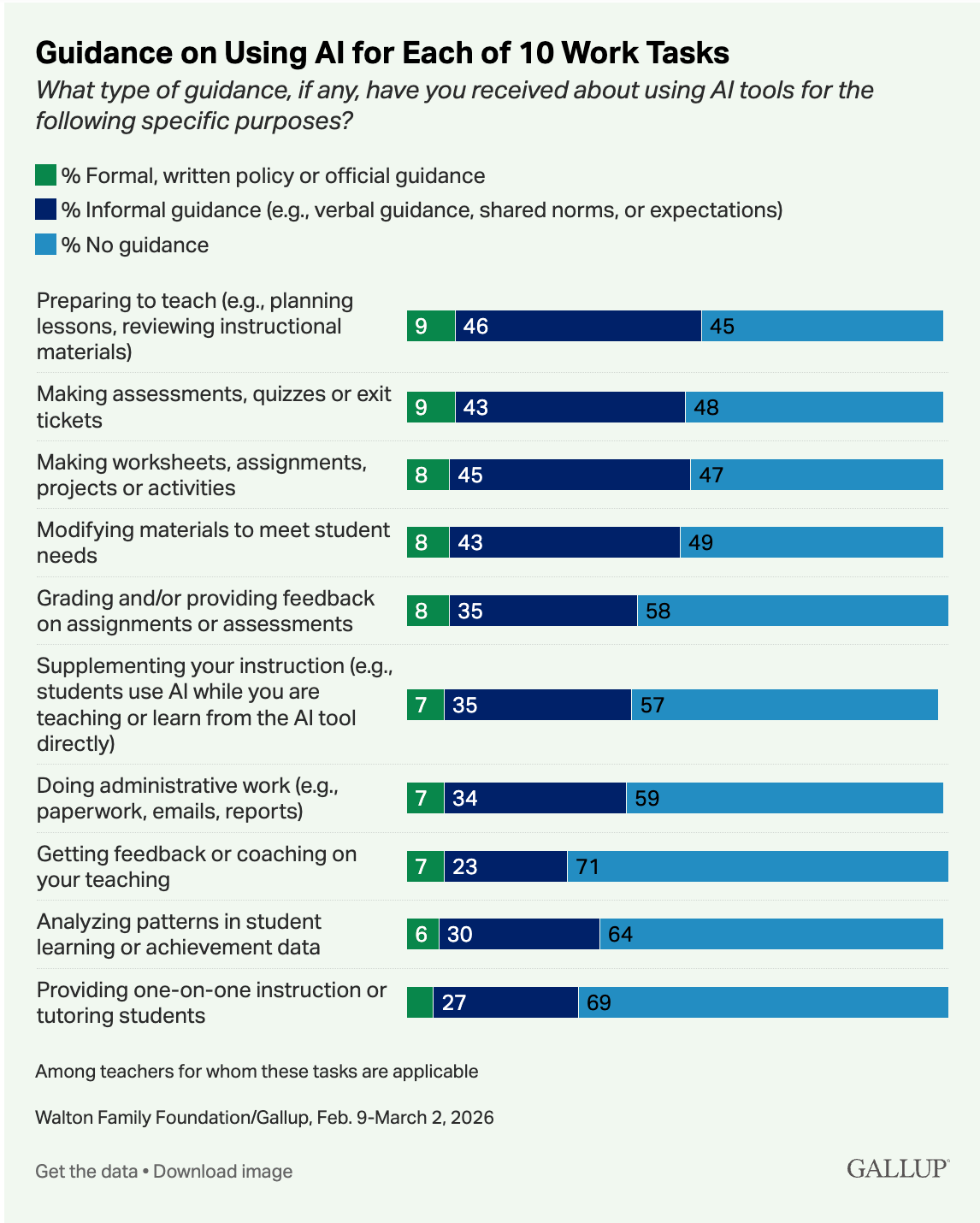
Gallup's "Bottom Line" is something that every school administrator should contemplate:
AI tools are becoming a routine part of teachers’ professional lives, but the institutional guidance that might help teachers use them thoughtfully and effectively has not kept pace. For most teachers, there is no formal policy, leaving individuals to make consequential decisions in a policy vacuum.
This is precisely the type of scenario that has created a seemingly endless number of educator cybertraps over the last thirty-plus years. Every new technology, of course, presents fresh challenges for educators. But the speed with which "AI" has swept through our educational system has turned the professional and ethical risks up to 11.
While the Teaching for Tomorrow project is collecting valuable data on the actual use of AI by the nation's teachers, there is one glaring omission: Data on whether we should be using AI in the classroom. That barn door, however, is wide open.
![Photo of an open barn door, Cook's Corner, Brunswick, Maine [Taken by Frederick Lane, 2021]](https://storage.ghost.io/c/4c/1b/4c1b2fc2-118c-4aa9-89a8-c6338a9e8763/content/images/2026/05/2021-07-23-United-States_ME_Brunswick_Barn.jpeg)
We are slowly coming to the realization that ultraprocessed foods are bad for us. I think that there is a growing realization that ultraprocessed data is just as bad, if not worse.
A telling coincidence occurred this morning, as multiple media outlets covered the dramatic victory of 14-year-old Shrey Parikh in the Scripps Spelling Bee. He earned his victory by spelling a remarkable 32 words in a 90-second spell-off.
A report from the day before that Google's latest iteration of AI is unable to spell the word "Google" unfortunately got much less attention. But is this the technology that 60% or more of teachers are using to help prepare lesson plans and worksheets?
Clearly, the ethical issues raised by the use of AI in the classroom are not limited to frontline teachers. School administrators, district leaders, state officials, legislators, and our tech data overlords all have a duty to better protect and educate our children.
As most of you probably are aware, Pope Leo issued his first encyclical, Magnifica Humanitas, a couple of weeks ago. I'll do a deeper dive into this thought-provoking document in the not-too-distant future, but there is one passage (from ¶ 145 of the encyclical) that is particularly relevant to today's discussion. So he gets the final Word:
Many educational systems struggle to keep pace with change and to support the integral development of students. The advance of information technologies and AI is rapidly rendering curricula obsolete that were designed for a different era. Meanwhile, the organization of schools, physical spaces, evaluation methods and the role of teachers themselves must be rethought in order to promote an authentically integral education that addresses every dimension of the person. It is necessary to support the ongoing formation of teachers throughout their professional lives, so that they can engage positively with new technologies, helping students to use them responsibly, critically and creatively, rather than passively succumbing to their influence.
![A photo showing view of the Untersberg from the entrance to Nonnberg Abbey, Salzburg, Austria [Frederick Lane 2024]](https://storage.ghost.io/c/4c/1b/4c1b2fc2-118c-4aa9-89a8-c6338a9e8763/content/images/size/w1304/format/webp/2026/08/2024-07-12_0719-Austria_Salzburg_Nonnberg-Abbey_Overlook-the-Untersberg.jpg)
![Photo of safety flag, Indian Wells Beach, Amagansett, NY [Frederick Lane, 2026]](https://storage.ghost.io/c/4c/1b/4c1b2fc2-118c-4aa9-89a8-c6338a9e8763/content/images/size/w1304/format/webp/2026/08/2026-08-10_0844-US_New-York_Amgansett_Indian-Wells-Beach_Safety-Flag.jpg)
![Photo of Hand-Carved Masks, Accra Arts Center, Accra, Ghana [Frederick Lane, 2023]](https://storage.ghost.io/c/4c/1b/4c1b2fc2-118c-4aa9-89a8-c6338a9e8763/content/images/size/w1304/format/webp/2026/08/2023-04-01_0652-Ghana_Accra_Hand-Carved-Masks.jpg)

