
![A photo of a vaguely-humanoid gas station sculpture, The Bronx, New York [Frederick Lane, 2022]](https://storage.ghost.io/c/4c/1b/4c1b2fc2-118c-4aa9-89a8-c6338a9e8763/content/images/size/w1304/format/webp/2026/07/2021-11-15-US_New-York_The-Bronx_Metal-Robot.jpg)
Table of Contents
After a grueling week of packing up our apartment in Brooklyn, it's been a real pleasure to hole up in a library and do some writing. So yes, this is a longer post than normal.
A story that caught my attention recently was the announcement that a school district in upstate New York purchased and was planning to deploy a humanoid robot this fall as a paraeducator in grade 11 and 12 classrooms. The new program was first announced by the manufacturing company Realbotix in a late June press release:
Realbotix Corp. ..., a leading developer of humanoid robots and AI systems, has launched Optio, its AI teacher’s assistant, in a pilot program at Salamanca City Central School District on the Seneca Nation Reservation in New York. As part of the initiative, the district is also deploying a Realbotix M-Series humanoid robot to enhance interactive classroom engagement and demonstrate embodied AI in education.
Many troubling issues were immediately evident: What does this portend for human educators? What impact will embodied AI have on students? Who is making decisions about the appearance of the robot, and what are the criteria for doing so? Which flavor of AI is powering the robot? How will its interactions with students be assessed? What guardrails are in place for inappropriate questions or answers? Can parents opt out on behalf of their children? Can the robot join the teacher's union?
Enough people started asking those questions (and several others, I suspect) that the district announced that it was pausing its pilot project to “work through enhanced student data privacy agreements” with the New York State Education Department. The district said it would also "continue engaging with our community and stakeholders," which many felt that the district had neglected to do in the first place.
The technology, privacy, and cybertraps issues in this story are enough to make it blogworthy. But as I began digging into the details, a whole other angle emerged. It's a wild story, one that weaves together themes I've been studying for about 30 years. So buckle up.
Sally Forth!
In June 2026, the Salamanca City Central School District voted to spend nearly $58,000 to purchase an AI-powered robot named "Sally" from a Toronto-based tech company called Realbotix. Sally is part of the company's M-series line of robots, which normally retail for about $95,000 per unit (the school apparently received an early adopter discount).
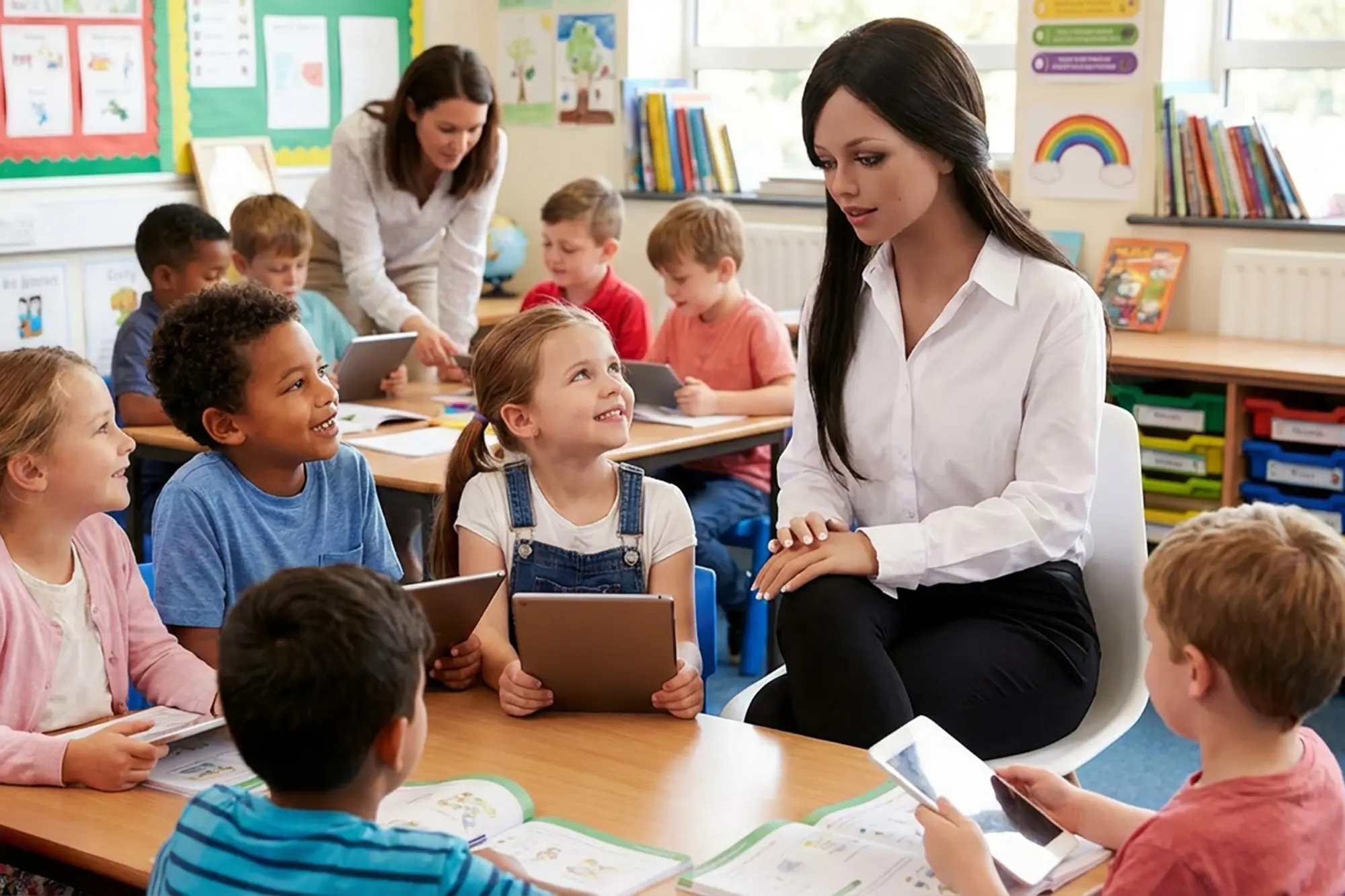
In an interview with New York Focus, a local non-profit news organization, Realbotix CEO Andrew Kiguel said that Sally will have "a 'lifelike appearance' with silicone skin and long brown hair." He added that the robot will remain in a sitting position, but will be able to interact with students through multiple positions and facial expressions. Kiguel praised the school district for its initiative:
This deployment in a working school district represents a landmark moment for both AI and humanoid robotics. Salamanca marks the beginning of a new era where humanoid robots and intelligent AI assistants become standard tools in STEM education.
The New York Post later reported that Sally will speak with "a western New York accent — similar to Buffalo native Gov. Kathy Hochul — at the behest of the school district."
Can a Robot Teach Robotics?
Before diving into the many, many legitimate concerns about this idea, it's only fair to lay out what the district hopes to accomplish by purchasing Sally (what Realbotix hopes to accomplish should be self-evident).
The school told reporters that Sally would initially work with 11th and 12th grade coding, AI, and robotics students, who are using curricula developed by Apple co-founder Steve Wozniak. The robot's AI will be limited to the curricula and will not have open access to the internet. In addition, the school said that Sally will not have access to personally identifying information about students. If a student wants to have a "conversation" with Sally, they can use a "unique identification code" so that the robot can access previous conversations, but that code will not be linked to the student's school records.
By using the Realbotix Optio software, Kiguel said, students can send photos of their homework to Sally for assessment and feedback. They can have real-time conversations with "her," get research ideas for topics that interest them, and have material translated from over 100 languages. (There is no information on whether Sally can speak the Seneca language, but given that Salamanca City Central School District is located entirely within the Seneca Nation Reservation, and a significant number of its students are members of the Seneca Nation, that seems like an obvious upgrade, particularly since Seneca is considered an endangered language.)
Realbotix also claims that Sally can be a valuable resource for teachers. Since Sally has the entire "Woz ED AI and Robotics" curriculum in her memory, she can help keep teachers on track or suggest prompts for students. Left unanswered are questions regarding the extent to which teacher performance will be monitored by Sally.
Salamanca Superintendent Mark Beehler said that the new program was an extension of the district's purposeful embrace of AI. “Many schools are taking the easy solution of simply banning it, but I have found that students will find a way around most rules that schools put in place,” Beehler told NY Focus. “I also believe it is critical for schools to teach proper use of technology, not simply exclude it.”
Not the Warmest of Receptions
As news coverage of Sally's planned deployment spread over the past month, numerous objections were raised by various members of the community.
Leading the charge was Lacey Pihlblad, the president of the Salamanica Teachers' Association and a teacher at the high school. She told The Guardian that she and her colleagues had serious concerns about the security of the Optio software and the AI used by Sally, as well as the collection, storage, and use of data collected by the Realbotix system.
There’s a growing consensus that indicates our students should be exposed to less technology. Placing a humanoid robot into the classroom to interact with our children, I believe, is a massive step in the wrong direction, and I believe that the majority of our teachers feel the same. If we’re going to do something of this magnitude, I feel we need to make sure that we do it the correct way, and I’m not sure that that’s currently what’s in place.
Pihlblad also said that the union was concerned "about the background of the company of Realbotix." More on that in a minute.
It has not escaped notice that the humanoid robot pilot program is being introduced in a school district located in a Native American reservation, with a school population that is nearly 80% economically disadvantaged. The public education advocacy group Alliance for Quality Education issued a powerful statement challenging the program:
This is following a pattern that has existed for far too long of allowing underserved students to become guinea pigs for untested ‘innovation’ in education, this time for replacing human relationships with machines. The years when children are developing socially, emotionally, and academically are not years we can afford to outsource to a robot, no matter how human it looks.
We have spent decades fighting to address the funding inequities that have historically left Black, Brown, Indigenous, and low-income communities behind, including the most basic technology like internet access and computers. It took a global pandemic for New York State to fully acknowledge the consequences of chronic underfunding and begin to address those technology gaps.
Sally and Her RealDoll Cousins
By itself, the announcement that an AI-powered humanoid robot would be deployed as a paraeducator in a rural New York school district would be enough to attract attention and debate. But what makes this story completely irresistible to the media is the fact that some of Sally's corporate cousins are literal sex dolls. And as ever, sex sells.
I've got some insight into this. Twenty-six years ago, I wrote Obscene Profits: The Entrepreneurs of Pornography in the Cyber Age (Routledge 2000). My book explored how a group of web-savvy entrepreneurs had figured out how to monetize the nascent internet and, in the process, helped launch a variety of technologies that transformed the digital world: web optimization techniques, demand for great bandwidth, online video, webcams, credit card processing, etc. Most of these technologies would eventually have emerged anyway, but the adult industry dramatically accelerated the development of the internet in the late 1990s and early 2000s. If you buy something online from Amazon or watch a video on YouTube, you can thank the adult industry (at least a little bit).
Savvy journalists quickly learned that Realbotix was formerly known as Tokens.com, a Canadian-based cryptocurrency company (the rebranding took place a little over two years ago).
In the spring of 2024, Tokens.com purchased a holding company called Simulacra Corporation. One of the companies held by Simulacra was Abyss Creations LLC, which was founded in 1997 (right at the beginning of the "Golden Age" of internet pornography) to develop anatomically correct sex dolls marketed under the brand name "RealDoll" (needless to say, wildly NSFW).
According to a profile statement for Simulacra in the corporate database Crunchbase, "The proprietary assets and artistic talent of Realdoll will expand into many markets on a worldwide scale when combined with the up-and-coming tech business Realbotix and the budding medical simulation company AFD."
The possibility that Sally may incorporate sex doll technology is not sitting well with some educators. As New York State United Teachers President Melinda Person put it, “a robot built by a company associated with sex dolls has no business in our classrooms."
Not surprisingly, both Realbotix CEO Kiguel and Superintendent Beehler are a bit huffy that the corporate dots have been connected. In a July 10 Facebook post, Beehler tried to rebut some of the most common objections, including the sexbot connection:
Myth: “It’s a companion robot.”
Fact: No. Realbotix develops robots for education, healthcare, hospitality, and customer service. This pilot is focused exclusively on enhancing teaching and learning.
A short time later, Realbotix offered its own defense of Sally's innocence:
For clarity, some media reports have falsely connected the Salamanca project to an adult product or adult-products business. The Salamanca robot is a newly manufactured, purpose-built educational unit; no existing product or hardware is being modified or repurposed for the school. Realbotix LLC focuses exclusively on non-adult commercial applications, including healthcare and education. No adult-products company has any involvement in the Salamanca project or in any product or project developed by Realbotix LLC. Separate companies.
There's a possibility that Realbotix is not being fully truthful here. The company is in the process of being acquired by a Cincinnati NASDAQ-listed biotech firm called Onconetix. Although Realbotix claims that the acquisition is intended to create more distance between its educational and sex doll divisions, Simulacra shareholders will "receive between 75 percent and 90 percent of Onconetix’s fully diluted shares at closing." That doesn't suggest a great deal of corporate separation.
The broader question is whether district administrators, educators, and parents should be concerned about the aluminum skeletons in Sally's corporate closet. While it's credible for Realbotix to say that its educational humanoid has been built to purpose, it's considerably less credible to assert that Sally has not benefitted from any of the technology developed by Simulacra/Abyss over the last thirty years.
My research files are filled with stories of educators (primarily female) who have been denied jobs or fired because of a connection with the adult industry (some remarkably tenuous). Sally may be made of virgin silicone, but thanks to the media coverage, curious students will definitely be looking up "Simulacra" and "RealDolls." I suspect that will be just as disruptive as a student teacher's R-rated photoshoot for Playboy.
And here are a couple of difficult questions for district administrators to ponder. What if a student is curious about just how anatomically correct Sally actually is? Would removal of her clothing to find out trigger the district's sexual misconduct policy? Is Realbotix planning to provide androgynous robots? Who will make the decision about just how "female" each robot is? The tech outlet CNET did a tour of the Abyss sex doll manufacturing plant in 2017, and one of the employees proudly said that every physical characteristic of a doll can be specified by customers. (If your IT department is doing its job, you can't watch the video at work, but administrators should see just how similar the appearance of some of the Abyss creations is to Sally. Frankly, the whole thing is wildly creepy.)
Sally 101: A Great Teachable Moment
My wife, Dr. Amy Werbel, who teaches at the Fashion Institute of Technology, has been grappling with the impact of AI on her students and her classes for the past several years. Like many other educators, she is deeply concerned about the impact of AI on students' ability to think critically and write coherently. Her suggestion: use the controversy over Sally as a teachable moment for the people most affected, both now and in the future – the students.
For instance, students in civic courses could discuss the process by which the decision to deploy Sally was made, and assess whether there was enough outreach to the school community, civic leaders, and state educational professionals.
A representative of Realbotix could be invited to address the district's AI and robotics students, and answer questions about design choices, pedagogical goals, privacy concerns, and so on.
And it's difficult to imagine a situation better suited for teaching journalism students about the power of investigation, records research, and sharp questioning. Many districts are too timid or too actively hostile to encourage such inquiries, but it's hard to think of a better opportunity to instill the values these kids will need in an AI-infused world.
![A photo showing view of the Untersberg from the entrance to Nonnberg Abbey, Salzburg, Austria [Frederick Lane 2024]](https://storage.ghost.io/c/4c/1b/4c1b2fc2-118c-4aa9-89a8-c6338a9e8763/content/images/size/w1304/format/webp/2026/08/2024-07-12_0719-Austria_Salzburg_Nonnberg-Abbey_Overlook-the-Untersberg.jpg)
![Photo of safety flag, Indian Wells Beach, Amagansett, NY [Frederick Lane, 2026]](https://storage.ghost.io/c/4c/1b/4c1b2fc2-118c-4aa9-89a8-c6338a9e8763/content/images/size/w1304/format/webp/2026/08/2026-08-10_0844-US_New-York_Amgansett_Indian-Wells-Beach_Safety-Flag.jpg)
![Photo of Hand-Carved Masks, Accra Arts Center, Accra, Ghana [Frederick Lane, 2023]](https://storage.ghost.io/c/4c/1b/4c1b2fc2-118c-4aa9-89a8-c6338a9e8763/content/images/size/w1304/format/webp/2026/08/2023-04-01_0652-Ghana_Accra_Hand-Carved-Masks.jpg)

