![Photo of Commuting Pigeons, Brooklyn, NY [Frederick Lane, 2026]](https://storage.ghost.io/c/4c/1b/4c1b2fc2-118c-4aa9-89a8-c6338a9e8763/content/images/size/w1304/format/webp/2026/06/US_New-York_Brooklyn_Pigeons.jpg)
Table of Contents
On the morning of May 18, 2026, Nina Williams received a text from her son, a student at Barrington Middle School in the Hillsborough County (Fla.) Public School System. Attached to the text was a video and photo that her son took during his art class that morning.
The video showed the art teacher, Karen Savage, wrapping an electrical cord around the neck of a black baby doll and tossing it over a TV mounted on the wall. The photograph, taken a few seconds later, shows the baby doll hanging from below the TV.
Williams took those materials and created a video montage, including publicly-available photos from Savage's social media and school pages. She posted the montage to Facebook, where it quickly attracted enormous attention. In her accompanying description, Williams described the impact of Savage's actions and the steps she took to raise awareness about the incident.
This emotionally affected ALL the children in that classroom. My son's friends of different cultures and races were all deeply offended and disturbed by this racist act. These kids stood united, grabbed evidence, and wrote official statements today.
This is NOT a classroom management tool. This is straight up hate and trauma being weaponized in front of our children in a place where they are supposed to be safe.
We spoke to the principal, and we are told the decision is now in the hands of the Hillsborough County school board / Professional Standards department. We are watching closely, and we are waiting to see exactly what this district is going to do. Will they protect our children, or will they protect a teacher who simulates a lynching in a classroom? This will NOT be swept under the rug!!
Spurred by Williams and the widespread publicity her post generated, school administrators acted with unusual speed. Savage was fired by the school district less than 48 hours later, and administrators reported her to the Florida Department of Education’s Office of Professional Practice Services for possible licensure action. Williams told a local television station that she and her family are considering further legal action against the district.
Not the First Teacher Caught on Video
Savage is hardly the first teacher to be recorded doing something inappropriate or even illegal in the classroom.
In 2026 alone, students have recorded a teacher urinating in the classroom (California); directing racist language at a student (Georgia, New York); using the n-word while asking why she (a white teacher) is forbidden from saying it (Nevada); and criticizing a school district's participation in the U.S. Department of Education-sponsored "History Rocks! 250 Campaign" (California).
As the Florida case illustrates, student recordings can play a valuable role in the investigation and resolution of allegations of educator misconduct. Virtually every school offers a range of alternative mechanisms for reporting potential problems, but in the absence of a video (or audio) recording, they all too often devolve into a "he said/they said" situation.
A Classic Double-Edged Sword
I've been following this issue ever since students began carrying cellphones with the ability to record video and distribute it instantly to a worldwide audience. Not surprisingly, tech-savvy students quickly figured out ways to make mischief with the new devices.
In the earliest days of smart devices, students engaged in the practice of "cyberbaiting" or "Youtubing" – purposely provoking teachers to act unprofessionally while another classmate records the exchange and posts it online.
That particular practice seems to have died down, but new threats have emerged. The most significant, of course, is deepfake videos. Thanks to widely available apps, it's far too easy – even for middle school students – to surreptitiously record video of a teacher and use software to manipulate what is seen or heard on the video.
While student video evidence can obviously be valuable evidence in the investigation of possible teacher misconduct, it's critical to remember Ronald Reagan's favorite Russian phrase: доверяй, но проверяй ("trust, but verify").
The daunting reality, of course, is that the rapid advances in generative AI will make verification increasingly difficult.
This Debate Is Bigger Than The Classroom
There's one other important wrinkle regarding the video that led to Savage's firing: It was recorded in violation of Florida law, which prohibits cellphone use by middle school students from "bell to bell." The fact that the video was recorded illegally, however, did not prevent school authorities from considering it during the investigation into Savage's conduct.
Florida's cellphone restrictions are part of a nationwide movement to cut back on student screen time in an effort to minimize disruptions, improve student attention span, and boost test scores. According to ABC News, 20 jurisdictions in the United States have complete bans, and another 16 have at least some limitations on student cellphone use.
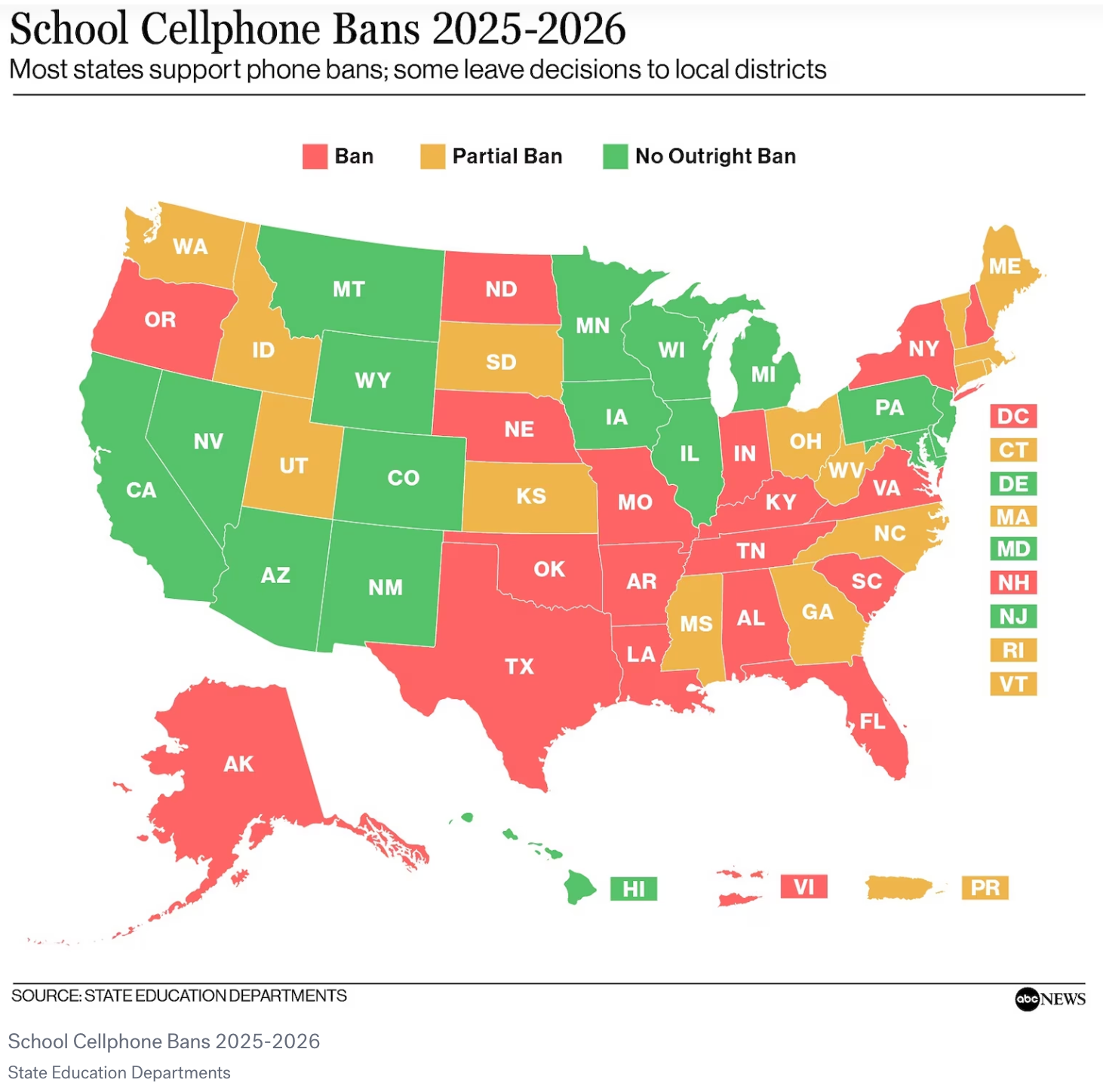
The effectiveness of student cellphone bans is still an open question.
A major study published in April by the National Bureau of Economic Research found that restrictions did lead to a significant decrease in nonacademic student usage during the school day, from 61 to 13 percent. But the bans did not necessarily produce promised academic improvements, and may have created new issues.
[T]he bans had a “close to zero” effect on test scores, according to the paper. Test scores are affected by many factors, including the stability of students’ home lives and the quality of teaching and curriculum. The researchers also noted that once cellphones had been banned, students might have been distracted by other forms of technology, such as laptops, which are ubiquitous in American classrooms.
The bans also did not improve student attendance or perceptions of online bullying. And in the first year after strict bans went into place, student suspensions increased by an average of 16 percent — a large and troubling change.
Many of the schools surveyed in the study require students to store their phones in secure pouches (Yondr is a popular option). Obviously, if Hillsborough County had deployed a similar product, Williams's son would not have been able to record the video in his art class. Would he and the other students have been believed by administrators?
Student device bans are well-motivated, but their logic is more superficial than it first appears. A decade of student classroom videos makes it clear that this issue is more nuanced than many legislators, administrators, and parents realize. And when the New York Times reports that "teachers have been thrilled" with the imposition of device restrictions, it's hard not to wonder if some of that is due to less accountability for what happens in the classroom.