
![Photo of Tlingit Hat by Preston Singletary, RISD Museum, Providence, RI [Frederick Lane, 2025]](https://storage.ghost.io/c/4c/1b/4c1b2fc2-118c-4aa9-89a8-c6338a9e8763/content/images/size/w1304/format/webp/2026/06/2025-11-26-US_New-York_New-York_Metropolitan-Museum_Glass-Bowl.jpg)
Table of Contents
New Hashtag, Old Cybertraps
I added a new hashtag to my Workflowy research files this week: #smartglasses. I've been following this technology for more than a decade, ever since Google's ill-fated attempt to make Google Glass a thing back in 2013.
Last week, for the first time, smart glasses were involved in sadly predictable K-12 cybertraps.
In Florida, students alleged that a middle school teacher in North Port used Meta smart glasses "to potentially record or photograph female students." Police are still investigating.
More disturbingly, in California, several middle school students in Santa Paula have been suspended [$$] for taking photos of female classmates and at least one female teacher with smart glasses, then using widely available AI software to "nudify" them. Police plan to turn the results of their investigation over to the Ventura County District Attorney, who may pursue either misdemeanor or felony charges.
The Ventura County Star article does not specify which brand of smart glasses the students used, but several options exist at prices ranging from $250 to $600 – with some available below $200. At those price points, many teachers and students can easily acquire this technology. As I discuss below, schools and districts need to act now to minimize the cybertraps of digital privacy invasions and electronic sexual assault.
Superhuman Vision: From Myth to Science
Superhuman sight – including the ability to see through solid objects – has been a part of human mythology for millennia. The ancient Greeks told of an Argonaut named Lynceus, who reportedly had the ability to see through walls, skin, and the ground itself. The Mayan origin story describes four humans created with "perfect vision," giving them the ability to see everything and everywhere. But in typical god fashion, the deities feared the competition and clouded their vision.
The Christian tradition offers its own version of all-seeing divine power:
Neither is there any creature that is not manifest in his sight: but all things are naked and opened unto the eyes of him with whom we have to do. – Hebrews 4:13 (KJV)
Enter science. In early November 1895, German scientist Wilhelm Röntgen identified a new type of radiation that he provisionally described as "X-rays." He proved their existence to an astonished world by making the first image of the inside of a human hand – that of his wife Anna Bertha Röntgen. When she saw the picture of the bones of her fingers, she reportedly exclaimed: "I have seen my death!" (She lived another 24 years.)
The technology moved fast. Just six months after Röntgen's discovery, Professor C.L. Norton at MIT was already using X-rays to see internal organs, diagnose illness, and study joint structure and movement. Röntgen's discovery helped lay the foundation for most of modern medical imaging, as well as a host of industrial applications. Fittingly, Röntgen was awarded the very first Nobel Prize for Physics in 1901.
From the Funny Pages to the Schoolyard
The idea of seeing through solid surfaces quickly grabbed the popular imagination and has never really let go. As early as 1907, a newspaper writer suggested that cricket umpires could benefit from "X-ray specs."
But the real surge in public interest began in 1938, when Jerry Siegel and Joe Shuster introduced the comic book hero Superman. Initially, the immigrant from Krypton was known for his speed, his strength, and his ability to leap tall buildings in a single bound. The following year, with little fanfare, Siegel and Shuster revealed Superman's iconic X-ray vision.
When you consider the typical readership of superhero comics in the mid-20th century (primarily middle and high school students), it's not surprising that novelty toy companies tried to cash in on the fascinating possibilities of X-ray vision. One of the best-known was Honor House Products, a New York company founded in 1951, which famously marketed "X-RAY SPECS" for "only $1.00."
Kirk Demarais, author of "Mail-Order Mysteries" (2011), explained how they worked to the New York Post: the cheap plastic (later cardboard) glasses promised "amazing X-ray vision instantly!" but delivered only an illusion created by bird feathers slotted into a small hole in each lens. The feathers refracted light, producing the appearance of two offset images.
"The Spex exemplify our naive hope that this stuff might work," Demarais said. "By the time I saw that ad, I knew X-ray vision wasn't possible, but you still have this hope."
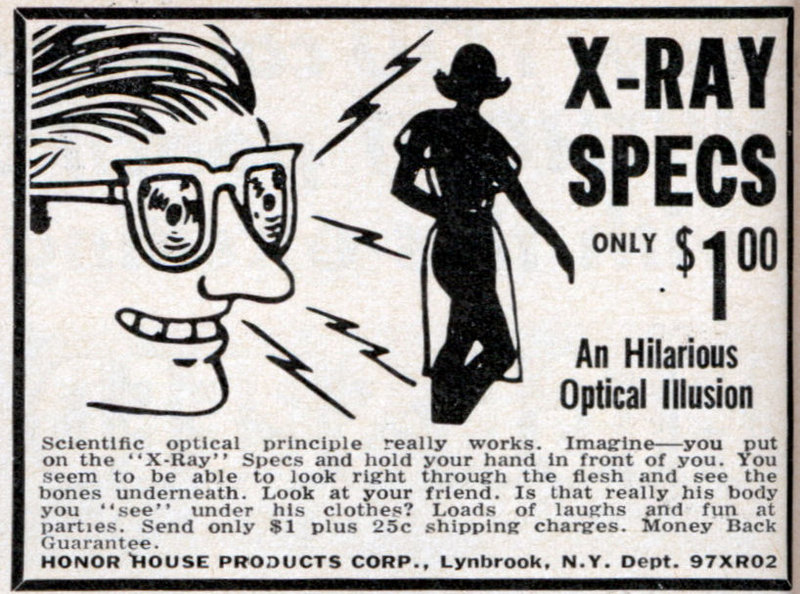
Honor House went out of business in 1981, roughly the same time that the personal computer was becoming a consumer product and just a couple of years before Timothy Berners-Lee invented the World Wide Web. When Steve Jobs and Apple introduced what was essentially the first mobile computer, the iPhone, in 2007, the industry took its first concrete steps towards what some call "ubiquitous computing." Over the ensuing twenty years, advances in miniaturization, processing speed, and AI have turned smartglasses into a legitimate consumer product.
What no one fully anticipated was that the same AI capable of analyzing what a smart glasses wearer sees and providing real-time context could also be weaponized to invade privacy and inflict serious emotional harm.
Software developers, device manufacturers, and online service companies are doing far too little to address the problem and establish necessary safeguards. In some cases, like Grok (I'm looking at you, Elon), there appears to be a conscious effort to exacerbate the harm. Courts and eventually legislatures will undoubtedly address these concerns (Musk, for one, is already facing numerous lawsuits for not doing enough about deepfake nudes).
But schools and school districts cannot afford to wait; there are reasonable steps every school can take to protect its students.
Five Things That Schools Should Do Right Now
Ban Smartglasses. There are very few non-pervy use cases for smartglasses in the K-12 environment. The pedagogical cost of banning these devices is negligible; the safety benefits are not. Just do it.
Update Professional Development. New technology rarely creates new cybertraps, but it does create new temptations. The relentless trend toward "smaller, cheaper, faster" means that smartglasses, with their nearly invisible cameras and silent image capturing, can lead some users toward behavior they might otherwise avoid. Professional development programs should be updated to help teachers and administrators understand what smartglasses are, what cybertraps they pose, and what ethical and professional standards apply.
Review Acceptable Use Policies. A school's acceptable use policy shouldn't be a constantly updated blacklist of forbidden devices and online services. That's an unwinnable game. Instead, policies should focus on impermissible behavior regardless of the tools used: invading someone's privacy, sexually harassing a classmate or colleague, or distributing indecent content.
Educate Students and Parents. When incidents like Santa Paula occur, one of the most common parent reactions is: "I had no idea this was even possible." Schools can and should help parents stay current on technology developments that affect the school environment. Students typically already know about tools like smart glasses and nudify apps. What they need instead is sustained guidance on the ethics and morality of how those tools should be used. That's primarily a parental responsibility, of course, but schools have an important supporting role to play.
Lobby Legislators. The harms enabled by smart glasses are a direct result of the indifference and "incelacious" attitudes of certain tech industry leaders. These are systemic problems that only coordinated legislative action can fully address, at the state, federal, and international levels. Administrators and educators, particularly through their unions, should be pushing hard for stronger regulations and meaningful accountability for companies that develop and distribute harmful technology, especially to children.

